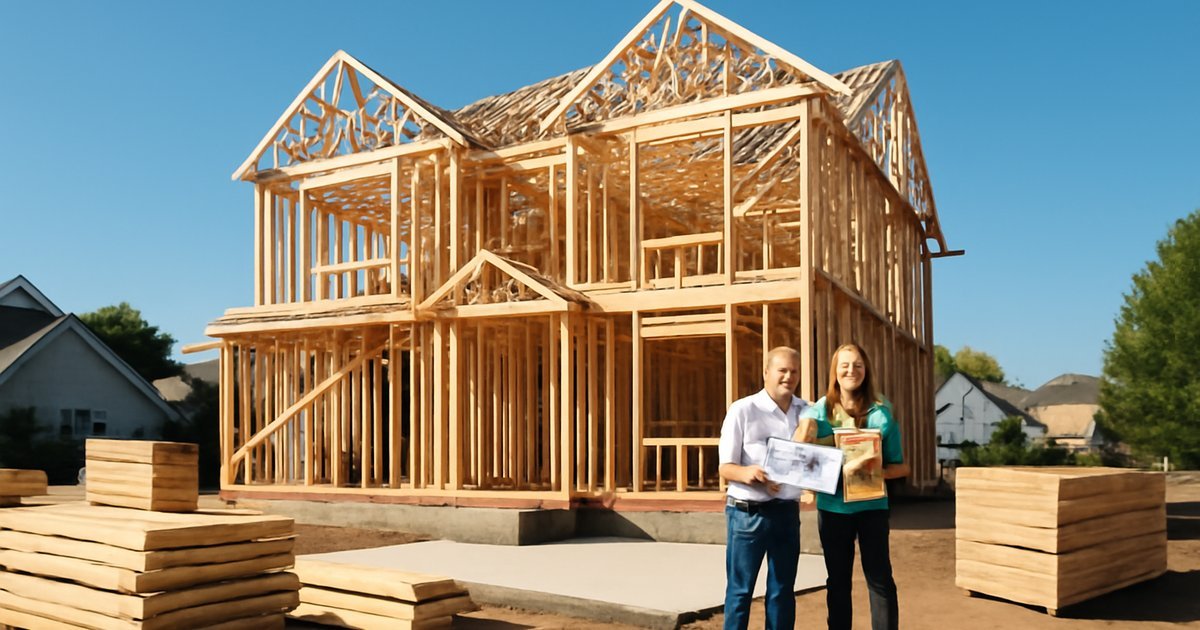
Building your dream home could cost you tens of thousands more if you choose the wrong financing — here’s what you need to know before breaking ground.
According to the U.S. Census Bureau, the average cost to build a new single-family home in the United States has surpassed $400,000 in recent years — and that figure doesn’t include the land. For most Americans, financing a new build is far more complicated than getting a traditional mortgage. That’s where construction loans come in.
Unlike a standard home loan, a construction loan is a short-term financing tool specifically designed to cover the cost of building a home from the ground up — or completing a major renovation. It works differently, costs more upfront, and comes with its own approval requirements.
In this guide, you’ll learn exactly how construction loans work, what they cost, how to qualify, and what mistakes can derail your project before the foundation is even poured. Whether you’re a first-time builder or a seasoned homeowner planning a major addition, this breakdown will help you make a smarter financing decision.
What Is a Construction Loan and How Does It Work?
A construction loan is a short-term, high-interest loan used to finance the building or significant renovation of a home. Unlike a traditional mortgage — where you borrow a lump sum secured by an existing property — a construction loan funds a project that doesn’t yet exist as a finished asset.
Lenders consider construction loans riskier than standard mortgages because there’s no completed home to secure the debt. If the builder walks off the job or costs spiral out of control, the lender is left with an unfinished structure. That’s why approval requirements are stricter and interest rates are generally higher.
Here’s the key mechanic: instead of receiving the full loan amount at once, funds are disbursed in draws — scheduled payments released at specific milestones during construction. Common draw stages include:
- Land purchase or preparation
- Foundation completion
- Framing
- Plumbing, electrical, and HVAC rough-in
- Interior finishes
- Final inspection and certificate of occupancy
During the construction phase — which typically lasts 6 to 18 months — you pay interest only on the amount drawn, not the total loan. Once the home is complete, the loan either converts to a permanent mortgage or you pay it off with a separate mortgage.
According to the Federal Reserve’s 2024 Senior Loan Officer Survey, construction and land development lending standards have tightened in recent years, making it more important than ever to understand what lenders are looking for before you apply.
Types of Construction Loans Available
Not all construction loans are structured the same way. Choosing the right type can save you thousands in closing costs and fees.
Construction-to-Permanent Loan (One-Time Close)
This is the most popular option. You close once, finance the construction phase, and then the loan automatically converts into a standard mortgage when the build is complete. You pay one set of closing costs, which typically run 2% to 5% of the total loan amount. This option offers convenience and rate certainty if you lock in early.
Construction-Only Loan (Two-Time Close)
With this structure, you take out a short-term loan to fund construction, then apply for a separate mortgage when the home is finished. You’ll pay closing costs twice — which adds up fast. However, this may work better if you expect your financial situation to improve by the time construction is complete, allowing you to qualify for better mortgage terms.
Owner-Builder Construction Loan
Designed for borrowers who want to act as their own general contractor. These are significantly harder to get — most lenders require documented construction experience, and many major lenders don’t offer them at all.
Renovation Construction Loan
Used for substantial renovations rather than new builds. The FHA 203(k) loan is a popular government-backed version of this product, allowing borrowers to finance both the purchase and renovation of a fixer-upper in a single loan. You can learn more about related financing strategies in our guide to Mortgage Pre-Approval: How It Works and Why You Need It.
Key Benefits of Construction Loans
When used correctly, construction loans offer several meaningful financial advantages for buyers who want to build rather than buy.
You only pay interest on what you’ve used. During the draw phase, interest accrues only on the disbursed amount — not the full loan. If your total loan is $500,000 but only $150,000 has been drawn, you’re paying interest on $150,000. This can reduce your monthly costs significantly during the build.
You can customize the home to your needs. Building new means you control energy efficiency, layout, materials, and technology — all of which can affect long-term costs and resale value.
New construction may have lower maintenance costs. According to the National Association of Home Builders, newly built homes typically require far fewer repairs in the first decade compared to older homes, which can offset the higher initial cost of building.
One-time close loans simplify the process. Locking in your rate and terms before construction begins protects you from rate increases during the build period — a meaningful benefit in a volatile interest rate environment.
Potential for appreciation. In high-demand markets, a newly built home in the right location can appreciate significantly between the time you break ground and the time you move in. That said, real estate values are never guaranteed — generally speaking, location and local market conditions drive outcomes.
How to Qualify: Step-by-Step
Qualifying for a construction loan is more demanding than qualifying for a standard mortgage. Here’s what you’ll typically need to prepare:
- Check your credit score. Most lenders require a minimum score of 680 for construction loans, and scores of 720 or higher will unlock better rates. Some lenders go as high as 700 as the floor. Pull your credit report at AnnualCreditReport.com and dispute any errors before applying.
- Prepare a down payment of 20% to 30%. Construction loans generally require a larger down payment than conventional mortgages. The industry standard is 20%, but many lenders require 25% to 30% depending on the project’s complexity and your financial profile. Some government-backed programs (like VA construction loans for eligible veterans) may allow lower down payments.
- Document your income and assets thoroughly. Lenders want to see two years of tax returns, W-2s or 1099s, recent bank statements, and proof of reserves. Self-employed borrowers typically face additional scrutiny. Having 6 to 12 months of cash reserves beyond your down payment strengthens your application considerably.
- Hire a licensed, approved builder. This is critical. Lenders don’t just underwrite the borrower — they underwrite the builder too. Your contractor must be licensed, insured, and have a demonstrable track record. Most lenders require a detailed construction contract and cost breakdown before approving the loan.
- Get a project appraisal. The lender will order an appraisal based on the proposed construction plans and comparable sales in the area. This "as-completed" appraisal determines your maximum loan amount. If the appraisal comes in low, you may need to increase your down payment or reduce the project scope.
- Submit your construction plans and budget. You’ll need detailed architectural plans, a materials list, a construction timeline, and a line-item budget. The more thorough your documentation, the faster your approval process will move.
- Close on the loan before construction begins. Once approved, you’ll sign loan documents and pay closing costs — typically 2% to 5% of the loan amount. Construction cannot begin until the loan closes.
For a broader understanding of how lenders evaluate your overall financial picture, see our article on Jumbo Loans: How They Work and If You Qualify.
Costs, Fees, and Risks to Understand
Construction loans come with a unique cost structure. Going in without understanding it can lead to serious budget shortfalls.
Interest rates are higher. Construction loan rates are typically 1% to 2% above conventional mortgage rates. In a market where 30-year fixed mortgage rates are in the 6% to 7% range, construction loan rates can run from 7% to 9% or higher, depending on your credit profile and the lender.
Closing costs apply — sometimes twice. With a two-time-close structure, you’ll pay closing costs on both the construction loan and the subsequent mortgage. On a $400,000 project, that’s potentially $16,000 to $40,000 in closing costs total.
Cost overruns are your responsibility. If construction costs exceed the loan amount — due to material price increases, labor shortages, or scope changes — you’ll need to cover the difference out of pocket. The IRS does not offer any deductions for construction loan interest during the build phase in most cases; once the home is your primary residence, mortgage interest deductibility may apply. Always verify with a CPA.
Construction delays can cost you. If the build runs longer than your loan term, you may need to extend it — which comes with extension fees and potentially higher interest costs. Build delays due to weather, supply chain issues, or contractor problems are common.
The draw inspection process adds fees. Each time a draw is requested, the lender typically sends an inspector to verify that the work has been completed as represented. Each inspection may cost $100 to $300, and there could be 5 to 10 inspections over the course of the project.
Liens from contractors and suppliers are a real risk. If your general contractor fails to pay subcontractors or material suppliers, those parties can file a mechanic’s lien against your property. Work with an attorney to use lien waivers at each draw stage.
Common Mistakes to Avoid
Many borrowers make avoidable errors that inflate costs or derail their projects entirely. Here are the most frequent — and most expensive — mistakes:
Mistake #1: Underestimating the total project budget. A common rule of thumb among builders is to add a 10% to 15% contingency buffer on top of your estimated costs. Material prices, labor rates, and permit fees can shift significantly during a multi-month build. Borrowers who don’t plan for overruns often find themselves scrambling for funds mid-project — sometimes forcing them to halt construction, which creates a cascade of additional costs.
Mistake #2: Choosing a builder the lender hasn’t vetted. Some borrowers fall in love with a contractor’s portfolio but skip the lender vetting process. If your builder can’t pass the lender’s qualification requirements, you may need to start your contractor search over — after you’ve already signed a contract. Always involve your lender early in the builder selection process.
Mistake #3: Not locking in your rate on a one-time-close loan. If you don’t lock your interest rate before construction begins and rates rise during the build, your permanent mortgage rate could be meaningfully higher than you projected. On a $400,000 mortgage, even a 0.5% rate difference adds up to more than $40,000 in additional interest over a 30-year term.
Mistake #4: Skipping the "as-completed" appraisal review. Many borrowers accept the appraisal without scrutinizing it. If the appraiser used poor comparable sales or misunderstood the plans, the appraisal may undervalue your finished home — reducing your loan amount and forcing a larger down payment. You have the right to request a reconsideration of value if you believe the appraisal is inaccurate.
Mistake #5: Ignoring the draw schedule’s impact on cash flow. Builders often need funds before a draw milestone is officially met. If your draw schedule doesn’t align with your contractor’s payment schedule, you may face pressure to pay out of pocket and get reimbursed — a cash flow crunch that catches many borrowers off guard.
Alternatives to Consider
A construction loan isn’t the right fit for everyone. Depending on your situation, one of these alternatives might make more sense:
FHA 203(k) Loan
Best for: Buyers purchasing a fixer-upper who want to finance both the purchase price and renovation costs in a single loan.
Pros: Lower down payment (as little as 3.5%), more lenient credit requirements (minimum score of 580 in most cases), government-backed security.
Cons: Loan limits apply (set by county), requires using FHA-approved contractors, and the renovation must meet FHA property standards. Not ideal for ground-up construction.
HELOC or Home Equity Loan
Best for: Existing homeowners who have significant equity and want to finance a major addition or renovation without building from scratch.
Pros: Lower rates than construction loans, flexible draw structure (HELOC), no need to qualify the project builder.
Cons: You’re putting your existing home at risk as collateral. Requires substantial equity. Not available for new builds on vacant land. For a detailed breakdown, see our guide to Jumbo Loans for context on how equity-based lending decisions are made.
Buying New Construction from a Builder
Best for: Buyers who want a new home but don’t need full customization and want simpler financing.
Pros: You use a standard mortgage to purchase a finished or near-finished home. No construction loan required. Builder may offer financing incentives.
Cons: Less customization, less control over materials and timeline, and builder incentives may come with strings attached (like using the builder’s preferred lender).
Frequently Asked Questions
Can I get a construction loan with a 650 credit score?
It’s difficult but not impossible. Most conventional lenders set the floor at 680 to 720. However, some portfolio lenders and credit unions may consider applicants with scores as low as 650 if other factors — such as a large down payment, strong reserves, or low debt-to-income ratio — compensate. Government-backed options like VA or USDA construction loans may have more flexibility for eligible borrowers.
How long does a construction loan last?
Most construction loans have a term of 12 to 18 months, corresponding to the expected build timeline. If construction is delayed, you can often request an extension — but lenders typically charge a fee, and the extension isn’t guaranteed. Always build a time buffer into your project plan.
Do I make monthly payments during construction?
Yes, but only on the interest accrued on drawn funds — not the full loan amount. Your monthly payment starts low and increases as more of the loan is disbursed. Principal repayment begins after the construction phase ends and the loan converts to a permanent mortgage.
Can I use a construction loan to build on land I already own?
Yes. In many cases, lenders will count the equity in land you already own toward your down payment requirement. If you own the land free and clear and it’s worth $80,000, and your total project cost is $400,000, that $80,000 may satisfy a 20% down payment threshold — though lender policies vary.
Is construction loan interest tax-deductible?
Generally speaking, interest paid during the construction phase is not immediately deductible. However, once you move in and the loan converts to a permanent mortgage, the interest may qualify as deductible home mortgage interest under IRS rules — subject to the $750,000 loan limit for mortgages originating after December 15, 2017. Consult a CPA for guidance specific to your situation.
Final Thoughts
Construction loans are powerful tools — but they’re also among the most complex financing products available to homebuyers. The draw structure, higher interest rates, builder vetting requirements, and cost overrun risks make them significantly more demanding than a standard mortgage.
The borrowers who succeed with construction loans are the ones who go in prepared: with strong credit, adequate reserves, a vetted builder, detailed plans, and a realistic budget that includes a contingency buffer.
If you’re serious about building, start by getting pre-qualified with two or three lenders to compare construction loan terms. Then work backward — choose your builder and finalize your plans based on what lenders will actually approve and fund.
Building a home is one of the largest financial decisions you’ll ever make. Taking the time to understand your financing options is one of the best investments you can make before the first shovel hits the ground.
This article is for educational purposes only and does not constitute financial, tax, or investment advice. Always consult a licensed financial advisor, CPA, or attorney before making financial decisions.
Leave a Reply