
Tag: home equity loan

  • Personal Loan vs. Home Equity Loan: Which Is Right for You?

    Personal Loan vs. Home Equity Loan: Which Is Right for You?

    Introduction

    Choosing the wrong loan type could cost you thousands of dollars in interest — here’s how to get it right.

    According to the Federal Reserve’s 2025 Consumer Credit Report, Americans collectively hold over $1.7 trillion in personal loan debt — and millions more tap their home equity every year to fund everything from renovations to debt consolidation. Yet many borrowers apply for whichever loan they find first, without comparing the real costs.

    That’s a costly mistake. The difference between a personal loan and a home equity loan can mean paying 8% interest versus 22% interest on the same borrowed amount — a gap that adds up to tens of thousands of dollars over the life of a loan.

    In this guide, you’ll learn exactly how personal loans and home equity loans work, who each one is best suited for, what they cost, and how to decide which option fits your financial situation. Whether you’re planning a home renovation, consolidating debt, or covering a major expense, this comparison will help you borrow smarter.


    What Is a Personal Loan vs. a Home Equity Loan?

    Before you compare rates and terms, it helps to understand the fundamental difference between these two products.

    Personal Loan

    A personal loan is an unsecured loan — meaning no collateral is required. You borrow a fixed amount, receive it as a lump sum, and repay it in fixed monthly installments over a set term (typically 2 to 7 years). Because lenders take on more risk without collateral, interest rates are generally higher.

    As of mid-2026, the average personal loan interest rate for borrowers with good credit hovers between 11% and 16% APR, according to Bankrate. Borrowers with poor credit can see rates as high as 30% or more.

    Home Equity Loan

    A home equity loan is a secured loan that uses your home as collateral. You borrow against the equity you’ve built — the difference between your home’s current market value and what you still owe on your mortgage. Like a personal loan, it’s a lump-sum product with fixed monthly payments.

    Because your home backs the loan, lenders take on less risk. Average home equity loan rates in 2026 range from 7% to 10% APR, depending on your credit score and loan-to-value (LTV) ratio.

    The key distinction: personal loans risk your credit score if you default; home equity loans risk your home.


    Key Benefits of Each Loan Type

    Why Personal Loans Make Sense

    No collateral required. If you don’t own a home — or don’t want to put it at risk — a personal loan gives you access to funds without pledging an asset.

    Faster funding. Many online lenders fund personal loans within 1 to 3 business days. Home equity loans typically take 2 to 6 weeks to close.

    Simpler process. No appraisal, no title search, no closing costs. You apply, get approved, and receive your money.

    Flexible use. Personal loans can be used for virtually anything — medical bills, weddings, travel, debt consolidation, or emergency expenses.

    Why Home Equity Loans Make Sense

    Significantly lower interest rates. If you have at least 20% equity in your home and a credit score above 680, you can access rates that personal loans simply can’t match.

    Larger loan amounts. Most personal loans cap out at $50,000 to $100,000. Home equity loans can go up to 80–90% of your home’s appraised value minus your mortgage balance, often enabling borrowing of $150,000 or more.

    Potential tax deduction. According to the IRS, interest on a home equity loan may be tax-deductible if the funds are used to buy, build, or substantially improve the home securing the loan. Consult a CPA to verify eligibility for your situation.

    Predictable payments. Like personal loans, home equity loans have fixed rates and fixed payments — making budgeting straightforward.

    If you’re also exploring revolving credit options backed by your home, check out our in-depth guide: HELOC vs. Home Equity Loan: Which Is Right for You?


    How to Get Started: Step-by-Step

    Whether you lean toward a personal loan or a home equity loan, the application process follows a similar framework. Here’s how to approach it strategically.

    1. Check your credit score. Pull your free credit report at AnnualCreditReport.com. Both loan types require a minimum credit score — generally 580–620 for personal loans and 620–680 for home equity loans. The higher your score, the better your rate.
    2. Calculate how much you need. Borrow only what you need. Over-borrowing increases your monthly payment and your total interest cost. Be specific: get contractor bids, medical estimates, or payoff balances before applying.
    3. Estimate your home equity (if applicable). Subtract your current mortgage balance from your home’s estimated market value. Most lenders allow you to borrow up to 80–85% of that equity. For example: $350,000 home value − $200,000 mortgage = $150,000 equity × 80% = $120,000 potential loan.
    4. Compare lenders. Get quotes from at least 3 lenders — banks, credit unions, and online lenders. Look at APR (not just the interest rate), loan terms, and fees. Many lenders offer prequalification with a soft credit pull that won’t affect your score.
    5. Gather your documents. For both loans: recent pay stubs, W-2s or tax returns (2 years), bank statements, and a government-issued ID. Home equity loans also require documentation of your mortgage and may require a home appraisal.
    6. Submit your application. Once you choose a lender, submit a full application. Expect a hard credit inquiry at this stage.
    7. Review the Loan Estimate carefully. For home equity loans, lenders are required by CFPB rules to provide a Loan Estimate within 3 business days of your application. Review every fee line before signing.

    Costs, Fees, and Risks

    This is where many borrowers get caught off guard. Understanding the full cost of each loan — not just the monthly payment — is essential.

    Personal Loan Costs

    • Origination fees: Typically 1%–8% of the loan amount, deducted upfront or rolled into the loan
    • Prepayment penalties: Some lenders charge a fee if you pay off early — check the fine print
    • Late fees: Usually $25–$50 per missed payment
    • Higher APR risk: If your credit score drops or you choose a bad lender, rates can climb sharply

    Home Equity Loan Costs

    • Closing costs: Typically 2%–5% of the loan amount, covering appraisal, title insurance, and origination fees — on a $100,000 loan, that’s $2,000 to $5,000 upfront
    • Appraisal fee: Usually $300–$700, sometimes required even if you don’t end up closing
    • Title search and insurance: $500–$1,500 depending on your state
    • Risk of foreclosure: This is the critical risk. If you default on a home equity loan, the lender can foreclose on your property. This is not a theoretical risk — it happens.

    Real-World Cost Comparison

    Say you borrow $30,000:

    • Personal loan at 14% APR over 5 years: Monthly payment ≈ $698 | Total interest ≈ $11,880
    • Home equity loan at 8% APR over 5 years: Monthly payment ≈ $608 | Total interest ≈ $6,480 (plus ~$1,500 in closing costs)

    Net savings on the home equity loan: approximately $3,900 — but only if you have the equity and the timeline to justify the closing costs.


    Common Mistakes to Avoid

    These are the errors that cost borrowers the most — and they’re entirely preventable.

    1. Choosing a Loan Based on Monthly Payment Alone

    A longer loan term lowers your monthly payment but dramatically increases the total interest paid. A $20,000 personal loan at 15% APR costs $4,776 in interest over 3 years versus $8,712 over 5 years. Always compare total cost, not just monthly payment.

    2. Using a Home Equity Loan for Non-Essential Spending

    Tapping your home equity to pay for a vacation, luxury purchase, or other discretionary spending is a high-risk move. If your home value drops or your income decreases, you could end up underwater — owing more than the home is worth. Reserve home equity borrowing for high-value uses like major renovations or consolidating high-interest debt.

    3. Ignoring Your Debt-to-Income Ratio (DTI)

    Lenders use your DTI — total monthly debt payments divided by gross monthly income — to assess approval. Most lenders want a DTI below 43% for home equity loans (CFPB guideline). Adding a new loan payment that pushes your DTI over this threshold not only risks denial but signals you may be over-leveraged.

    4. Skipping the Rate Comparison

    Accepting the first offer without shopping around is one of the most common and expensive mistakes in borrowing. According to Freddie Mac research, getting just two rate quotes saves borrowers an average of $1,500 over the life of a loan. Getting five quotes saves even more.

    5. Forgetting About Fees When Comparing APRs

    Two loans with the same interest rate can have very different true costs if one has high origination fees or closing costs. Always compare APR (Annual Percentage Rate), which incorporates fees — not just the advertised interest rate.


    Alternatives to Consider

    If neither a personal loan nor a home equity loan feels right, here are three alternatives worth evaluating.

    1. HELOC (Home Equity Line of Credit)

    Best for: Ongoing expenses or projects with uncertain total costs (like a multi-phase renovation).
    How it works: A revolving credit line backed by your home equity — you draw funds as needed and only pay interest on what you use.
    Downside: Variable interest rates mean your payment can fluctuate. Our guide on HELOC vs. Home Equity Loan covers this in detail.

    2. 0% APR Credit Card (Balance Transfer or Purchase)

    Best for: Smaller amounts ($5,000–$20,000) you can repay within 12–21 months.
    How it works: Many cards offer 0% intro APR periods. If you pay off the balance before the promotional period ends, you pay zero interest.
    Downside: If you carry a balance past the intro period, standard rates (often 20%+) apply to the remaining balance. Discipline is critical.

    3. FHA Title I Home Improvement Loan

    Best for: Homeowners who lack sufficient equity for a home equity loan but need to fund home improvements.
    How it works: Government-backed loans up to $25,000 for single-family homes, with no equity requirement in some cases.
    Downside: Limited to home improvement purposes; not suitable for debt consolidation or other uses. Learn more in our guide on FHA Loans: How They Work and If You Qualify.


    Frequently Asked Questions

    What credit score do I need for a personal loan?

    Most lenders require a minimum score of 580–620 for approval, though the best rates go to borrowers with scores of 720 or above. Some lenders specialize in bad-credit personal loans, but expect significantly higher APRs — often 25%–36%.

    How much equity do I need to qualify for a home equity loan?

    Generally, lenders require you to retain at least 15%–20% equity in your home after the loan closes. So if your home is worth $400,000 and you owe $300,000, you have 25% equity — enough to qualify with most lenders, though your borrowing capacity will be limited.

    Is the interest on a personal loan tax-deductible?

    In most cases, no. Personal loan interest is not tax-deductible unless the loan is used specifically for business purposes and you can document that use. Always verify with a CPA for your situation.

    How long does it take to get approved for each loan?

    Personal loans from online lenders can be approved and funded in 1–3 business days. Home equity loans typically take 2–6 weeks due to the appraisal, title search, and closing process.

    Can I use a home equity loan to consolidate credit card debt?

    Yes — and it can be a smart move if your credit cards carry high interest rates (20%+) and you have low-rate home equity available. However, you’re converting unsecured debt into debt secured by your home. If you later struggle to make payments, your home is at risk. This strategy requires financial discipline to avoid running up new credit card balances after consolidation.


    Conclusion

    Choosing between a personal loan and a home equity loan comes down to three core factors: how much you need to borrow, whether you have sufficient home equity, and how much risk you’re comfortable with.

    If you need quick access to $10,000–$30,000 and don’t want to put your home on the line, a personal loan offers speed and simplicity — at a higher rate. If you have meaningful equity, a strong credit profile, and the patience for a longer closing process, a home equity loan can save you thousands in interest, especially on larger amounts.

    In most cases, the right answer depends on your specific financial picture. Run the numbers, compare at least three lenders, and consider both the monthly payment and the total cost over the life of the loan.

    Take your next step today: check your credit score, estimate your home equity, and request prequalification quotes from two or three lenders — with no obligation and no impact to your credit score.

    This article is for educational purposes only and does not constitute financial, tax, or investment advice. Always consult a licensed financial advisor, CPA, or attorney before making financial decisions.
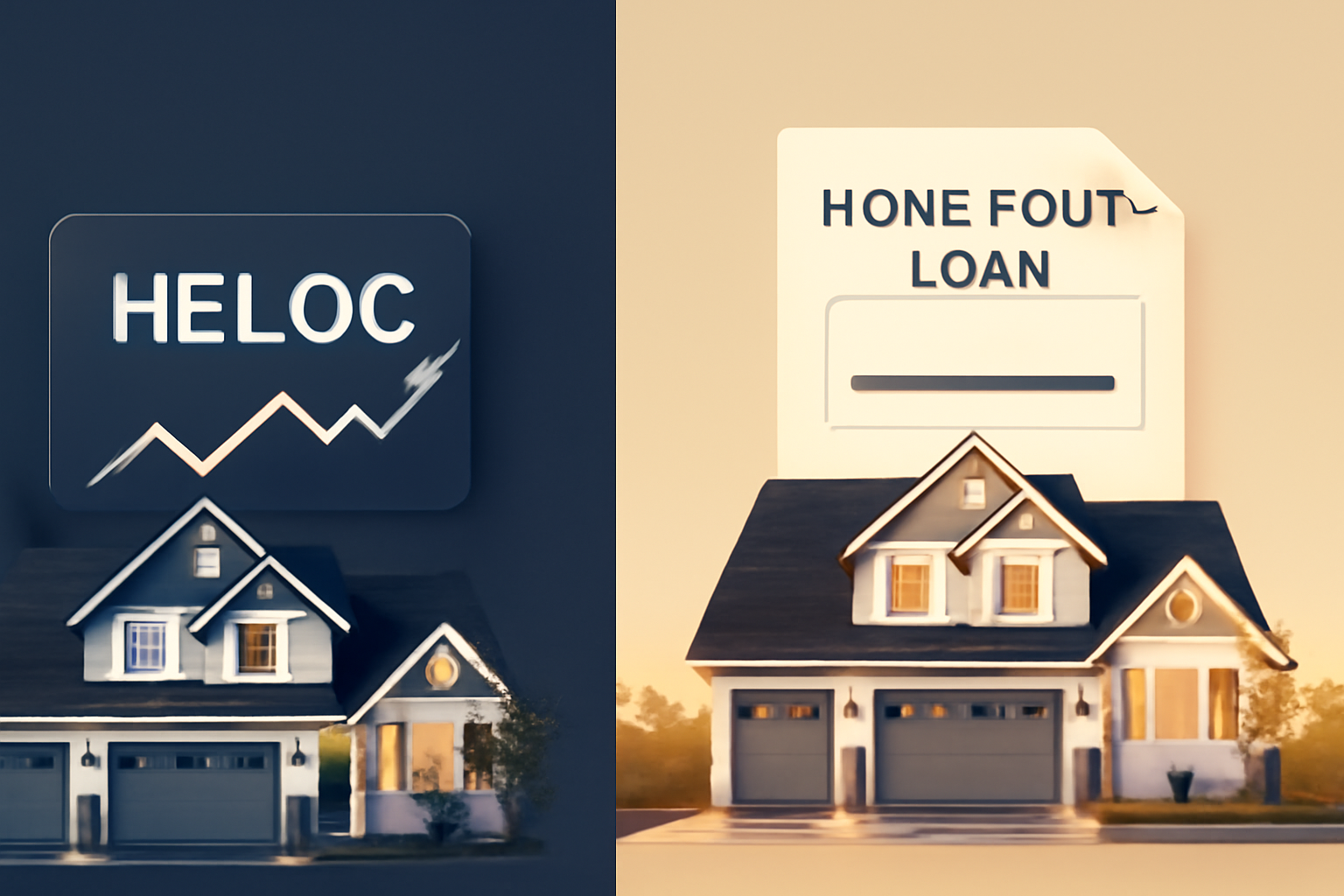
  • HELOC vs. Home Equity Loan: Which Is Right for You?

    HELOC vs. Home Equity Loan: Which Is Right for You?

    Two Powerful Ways to Tap Your Home’s Equity — But They Work Very Differently

    Homeowners who choose the wrong equity product can pay thousands more in interest — here’s how to pick the right one.

    According to a 2026 report from the Federal Reserve, American homeowners collectively hold over $32 trillion in home equity — a record high. If you’ve owned your home for several years, there’s a good chance you’re sitting on a significant financial resource. The question is: how do you access it wisely?

    Two of the most popular options are a Home Equity Line of Credit (HELOC) and a Home Equity Loan. Both let you borrow against the value you’ve built in your home. But they work in very different ways — and picking the wrong one for your situation could mean paying thousands of dollars more in interest, or getting locked into a structure that doesn’t match your needs.

    In this guide, you’ll learn exactly how each product works, what they cost, when to use each one, and what mistakes to avoid. Whether you’re planning a home renovation, consolidating debt, or covering a major expense, this breakdown will help you make a confident, informed decision.


    What Is a HELOC and How Does It Work?

    A Home Equity Line of Credit (HELOC) is a revolving line of credit — think of it like a credit card, but secured by your home. Your lender approves you for a maximum credit limit based on your home’s equity, and you can draw from it as needed during what’s called the draw period, which typically lasts 5 to 10 years.

    During the draw period, you usually only pay interest on what you’ve borrowed — not the full credit limit. Once the draw period ends, you enter the repayment period (typically 10 to 20 years), during which you pay back both principal and interest.

    HELOCs have variable interest rates in most cases. That means your monthly payment can fluctuate as market rates change. As of mid-2026, average HELOC rates generally range from 8% to 10%, according to Bankrate — though your actual rate depends on your credit score, loan-to-value ratio, and the lender.

    A HELOC is best suited for situations where you need ongoing access to funds over time — like a multi-phase home renovation or an irregular expense you can’t predict upfront.


    What Is a Home Equity Loan and How Does It Work?

    A Home Equity Loan is a lump-sum loan secured by your home’s equity. Unlike a HELOC, you receive the full amount at once and repay it in fixed monthly installments over a set term — typically 5 to 30 years.

    Home equity loans almost always carry fixed interest rates, which means your payment stays the same every month for the life of the loan. This predictability makes budgeting straightforward and protects you from rate increases.

    According to NerdWallet, average home equity loan rates in 2026 generally fall between 7.5% and 9.5%, depending on creditworthiness and loan term. Because rates are fixed, these loans tend to be slightly lower than variable HELOC rates when market conditions are volatile.

    A home equity loan works well when you have a specific, one-time expense with a known cost — like a roof replacement, medical bill, or debt consolidation payoff.


    Key Differences: HELOC vs. Home Equity Loan at a Glance

    Before diving into specific use cases, here’s a side-by-side comparison of the core features:

    • Structure: HELOC = revolving credit line | Home Equity Loan = lump-sum installment loan
    • Interest rate: HELOC = typically variable | Home Equity Loan = typically fixed
    • Disbursement: HELOC = draw as needed | Home Equity Loan = one-time payout
    • Monthly payment: HELOC = fluctuates based on balance and rate | Home Equity Loan = fixed and predictable
    • Best for: HELOC = ongoing or uncertain expenses | Home Equity Loan = known, one-time costs
    • Risk: HELOC = rate spike risk | Home Equity Loan = locked in even if rates fall

    Both products use your home as collateral — which means failure to repay can result in foreclosure. That’s a critical risk to understand before you borrow against your home equity.


    How to Qualify for Either Product

    Lenders generally look at the same factors for both HELOCs and home equity loans. Here’s what you’ll typically need:

    1. Home equity of at least 15%-20%: Most lenders require you to retain at least 20% equity in your home after borrowing. If your home is worth $400,000 and you owe $280,000, you have $120,000 in equity — but lenders may only let you borrow up to $40,000-$60,000 depending on their combined loan-to-value (CLTV) limits.
    2. Credit score of 620 or higher: Most lenders require a minimum score of 620, but to get the best rates, you’ll generally want a score of 700 or above. The CFPB recommends checking your credit report before applying.
    3. Debt-to-income ratio (DTI) below 43%: Your DTI measures your monthly debt payments against your gross income. Most lenders cap this at 43%, though some go as low as 36% for the best terms.
    4. Stable income and employment history: Lenders typically want to see at least two years of steady employment or self-employment income. You’ll need to provide W-2s, tax returns, and recent pay stubs.
    5. A current home appraisal: Your lender will order an appraisal to confirm your home’s current market value before approving either product.

    If you’ve recently refinanced your mortgage, it’s worth reviewing our guide on Mortgage Refinancing: When It Makes Sense and How to Do It to understand how a refinance may affect your equity position before applying for a HELOC or home equity loan.


    Costs, Fees, and Tax Implications

    Both products come with costs beyond the interest rate. Understanding the full cost picture is essential before you commit.

    Closing Costs

    Home equity loans typically come with closing costs ranging from 2% to 5% of the loan amount — similar to a first mortgage. On a $50,000 loan, that’s $1,000 to $2,500 upfront. HELOCs often have lower or waived closing costs, but some lenders charge annual fees of $50 to $100, plus inactivity fees if you don’t use the line.

    Early Closure / Prepayment Penalties

    Some lenders charge a fee if you close a HELOC within the first 2-3 years — sometimes $500 or more. Home equity loans may also carry prepayment penalties, though these are less common. Always read the fine print before signing.

    Tax Deductibility

    This is one of the most misunderstood areas. Under current IRS rules (as established by the Tax Cuts and Jobs Act and still applicable as of 2026), interest on home equity debt is only deductible if the funds are used to buy, build, or substantially improve the home that secures the loan.

    If you use a HELOC to pay off credit card debt or fund a vacation, that interest is not deductible. If you use it to renovate your kitchen, it generally is — up to the applicable mortgage interest deduction limits. Consult a CPA to confirm deductibility for your specific situation.

    Variable Rate Risk (HELOC)

    Because most HELOCs are tied to the prime rate, a rise in interest rates can significantly increase your monthly payment. If you borrow $60,000 on a HELOC at 8.5% and rates rise to 10.5%, your interest-only payment jumps from roughly $425/month to $525/month — a $1,200 increase per year on the same balance.


    Common Mistakes to Avoid

    People who rush into home equity borrowing often make one of these costly errors:

    1. Borrowing More Than You Need

    Just because you qualify for $100,000 doesn’t mean you should take it. Every dollar you borrow is backed by your home. Over-borrowing increases your risk of going underwater (owing more than your home is worth) if property values dip. Borrow only what you genuinely need.

    2. Ignoring the Variable Rate Risk on HELOCs

    Many borrowers choose a HELOC because the initial rate looks attractive — but they don’t plan for rate increases. If you’re on a fixed income or tight budget, a variable rate can cause real financial strain. If predictability matters to you, a home equity loan’s fixed rate is the safer choice.

    3. Using Home Equity for Depreciating Assets

    Using your home as collateral to buy a car, fund a vacation, or cover everyday expenses is a high-risk move. If you can’t make payments, you could lose your home. Home equity is best reserved for expenses that add value — home improvements, education, or eliminating high-interest debt with a clear payoff plan.

    4. Not Shopping Multiple Lenders

    According to the CFPB, borrowers who compare at least three lenders save an average of $1,500 over the life of a loan. Rates and fees vary significantly between banks, credit unions, and online lenders. Don’t settle for the first offer — especially on a large loan backed by your home.

    5. Forgetting About the Repayment Phase on HELOCs

    During the draw period, interest-only payments feel affordable. But when the repayment phase kicks in, your payment can jump dramatically because you’re now paying principal too. Make sure you understand what that transition looks like — and that you can handle the increased payment.


    Alternatives to Consider

    If a HELOC or home equity loan doesn’t feel like the right fit, here are three alternatives worth evaluating:

    1. Cash-Out Refinance

    How it works: You refinance your existing mortgage for more than you owe and receive the difference in cash.
    Pros: Single monthly payment; fixed rate available; potentially lower rate than a second lien.
    Cons: You restart your mortgage term; closing costs can be $5,000-$10,000+; only makes sense if current rates are close to or below your existing rate. See our full guide on Mortgage Refinancing for a deeper breakdown.

    2. Personal Loan

    How it works: An unsecured loan with a fixed rate and term — no collateral required.
    Pros: Fast approval; no risk to your home; no appraisal needed.
    Cons: Interest rates are typically higher (often 10%-20%+); loan limits are lower, usually $50,000 or less. Best for smaller expenses where you don’t want to risk your home equity.

    3. 0% APR Balance Transfer Card

    How it works: Move high-interest debt to a card with a 0% introductory APR for 12-21 months.
    Pros: No interest during the promo period; no collateral required; works well for a manageable debt amount.
    Cons: You need excellent credit; after the promo period ends, rates spike to 25%+; not useful for large expenses. Our guide to the Best Balance Transfer Credit Cards covers how to use these strategically.


    Frequently Asked Questions

    Can I have both a HELOC and a home equity loan at the same time?

    Yes, in some cases. However, your combined loan-to-value ratio must stay within your lender’s limits — typically no more than 80%-85% of your home’s appraised value. Having both increases your monthly obligations and your risk if home values decline.

    How long does it take to get approved?

    Both products typically take 2 to 6 weeks from application to funding. The timeline depends on how quickly your lender can order an appraisal and process documentation. Some online lenders advertise faster timelines, but 3-4 weeks is realistic for most borrowers.

    What happens if I sell my home before the loan is paid off?

    Both a HELOC and a home equity loan must be repaid at closing when you sell your home. The proceeds from the sale are used to pay off your first mortgage and then your home equity debt. If your sale price doesn’t cover both, you’d owe the difference.

    Is a HELOC a good idea for an emergency fund?

    Some financial planners suggest keeping an open HELOC as a backup emergency resource — since you only pay interest when you draw from it. However, lenders can freeze or reduce your HELOC during economic downturns (as many did in 2008-2009), which means it may not be available exactly when you need it most. A high-yield savings account is a more reliable emergency fund — check out our comparison of High-Yield Savings Accounts for context.

    Will applying for a HELOC or home equity loan hurt my credit score?

    Yes, briefly. Lenders will run a hard inquiry on your credit report, which typically drops your score by 5-10 points temporarily. Once you open the account and begin making on-time payments, your score generally recovers and may improve over time.


    The Bottom Line: Which One Is Right for You?

    Here’s a simple framework to guide your decision:

    • Choose a HELOC if you have ongoing or uncertain expenses (like a multi-stage renovation), you’re comfortable with variable rates, and you want flexibility to borrow only what you need over time.
    • Choose a Home Equity Loan if you have a specific, one-time expense with a known cost, you want a fixed monthly payment, and rate predictability is more important than flexibility.

    In either case, approach home equity borrowing with discipline. Your home is likely your most valuable asset — protecting it means borrowing thoughtfully, comparing multiple lenders, and having a clear repayment plan before you sign anything.

    Start by getting your credit report (free at AnnualCreditReport.com), calculating your current equity, and reaching out to at least three lenders for rate quotes. The preparation you do now will directly impact how much this decision costs you over the next decade.

    This article is for educational purposes only and does not constitute financial, tax, or investment advice. Always consult a licensed financial advisor, CPA, or attorney before making financial decisions.